
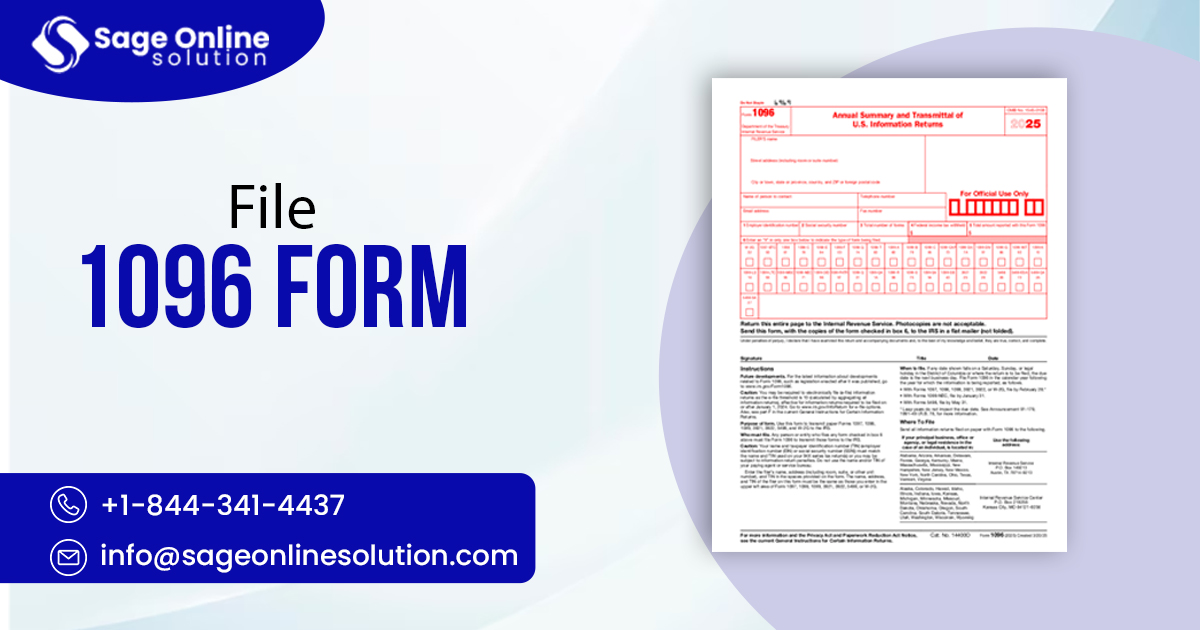
If you're a business owner, independent contractor, or someone who needs to report payments to the IRS, understanding what is the 1096 form is essential for staying compliant with federal tax requirements. For immediate assistance with your Form 1096 questions, you can contact the IRS helpline at +1(844)341-4437. This form serves as a summary transmittal document that accompanies various information returns you submit to the Internal Revenue Service.
Form 1096 acts as a cover sheet for paper-filed information returns such as Forms 1099, 1098, 5498, and W-2G. Think of it as the envelope that bundles together all your information returns before sending them to the IRS. Without this critical document, your information returns may not be processed correctly, potentially leading to penalties and compliance issues.
The purpose of Form 1096 is to provide the IRS with a summary of the information returns you're submitting. It includes totals of all the forms you're sending, the number of forms included, and your contact information as the filer. This allows the IRS to verify that all the individual forms you're submitting match up with the summary information you're providing.
Businesses and individuals use Form 1096 when they've made payments throughout the year that require reporting to the IRS. Common scenarios include paying independent contractors, distributing dividends, reporting mortgage interest received, or documenting gambling winnings. If you're required to file any 1099 series forms on paper, you'll need to include a Form 1096 with your submission.
Where to Find Form 1096
Obtaining Form 1096 is straightforward and can be done through several channels. The most direct method is to download it from the official IRS website at IRS.gov. Navigate to the "Forms and Instructions" section and search for "Form 1096." The IRS provides the current year's form as well as previous years' versions if you need to file for past tax periods.
You can also order official IRS forms by calling the IRS forms ordering service. Keep in mind that when filing paper returns, you must use the official red-ink scannable forms provided by the IRS. Forms printed from your home printer on regular paper are not acceptable for submission because the IRS uses scanning equipment that requires the special red ink.
Many office supply stores carry IRS forms during tax season, including Form 1096. This can be a convenient option if you prefer to have physical forms on hand immediately. Additionally, if you work with a tax professional or accountant, they typically have access to these forms and can provide them as part of their services.
Tax software programs that handle information return filing often include Form 1096 as part of their package. However, it's important to note that if you file electronically through the IRS FIRE system (Filing Information Returns Electronically), you don't need Form 1096 at all—it's only required for paper submissions.
For businesses that regularly file information returns, ordering forms in bulk directly from the IRS at the beginning of each tax year can ensure you always have the correct forms when you need them. The IRS updates forms annually, so make sure you're using the current year's version to avoid processing delays.
How to Fill Out a 1096 Form
Completing Form 1096 accurately is crucial for proper processing of your information returns. The form itself is relatively straightforward, but attention to detail is essential to avoid rejections or penalties.
Start by entering your name and address in the designated boxes at the top of the form. If you're filing as a business, use your business name exactly as it appears on your tax returns. For your address, use the same address you use on your federal tax return to maintain consistency across all IRS documentation.
Next, enter your Employer Identification Number (EIN) or Social Security Number (SSN) in the appropriate box. Businesses typically use an EIN, while individuals might use their SSN if they don't have an EIN. This identifier is critical because it links your Form 1096 to your tax account with the IRS.
The form requires you to indicate the type of forms you're submitting by checking the appropriate box. There are boxes for different types of 1099 forms (1099-MISC, 1099-NEC, 1099-INT, etc.), as well as other information returns like Form 1098. You can only submit one type of form per Form 1096, so if you're filing multiple types of information returns, you'll need a separate Form 1096 for each type.
Enter the total number of forms you're submitting in the designated box. Count each individual information return—for example, if you're submitting twenty 1099-NEC forms, you would enter "20" in this field. This allows the IRS to verify that they've received all the forms you're claiming to send.
You must also provide the total federal income tax withheld across all the forms you're submitting. Add up the amounts from Box 4 of all your information returns and enter the total. If you didn't withhold any federal income tax, enter zero.
Similarly, calculate and enter the total amount reported in Box 1 (or the main payment box) of all the forms you're submitting. This represents the total payments you're reporting to the IRS for that particular type of form.
Include your contact information, including a name and telephone number of the person the IRS can contact if there are questions about the forms. This is typically the business owner, office manager, or tax preparer.
Finally, sign and date the form. Form 1096 must be signed by the filer or an authorized representative. Without a signature, the form is considered incomplete and may be rejected.
Where to Mail Form 1096
Once you've completed Form 1096 and gathered all your information returns, knowing where to mail Form 1096 is the next critical step. The IRS has different addresses depending on your location and the type of forms you're submitting.
The mailing address is not universal—it varies based on which state you're filing from. The IRS maintains several service centers across the country, and you need to send your forms to the correct center for your jurisdiction. Using the wrong address can significantly delay processing.
For most filers, the addresses are divided into two categories: those with a return address in specific states and those without. You can find the current mailing addresses in the instructions for Form 1096 on the IRS website, as these addresses occasionally change.
If you're located in states like Alabama, Arizona, Arkansas, Connecticut, Delaware, Florida, Georgia, Kentucky, Louisiana, Maine, Massachusetts, Mississippi, New Hampshire, New Jersey, New Mexico, New York, North Carolina, Ohio, Pennsylvania, Rhode Island, Texas, Vermont, Virginia, or West Virginia, you'll use the Department of the Treasury Internal Revenue Service Center in Austin, TX.
For filers in Alaska, California, Colorado, Hawaii, Idaho, Illinois, Indiana, Iowa, Kansas, Michigan, Minnesota, Missouri, Montana, Nebraska, Nevada, North Dakota, Oklahoma, Oregon, South Dakota, Tennessee, Utah, Washington, Wisconsin, or Wyoming, the appropriate address is the Department of the Treasury Internal Revenue Service Center in Kansas City, MO.
It's advisable to mail your Form 1096 and accompanying information returns using certified mail with a return receipt requested. This provides proof of mailing and delivery, which can be invaluable if there's ever a question about whether you filed on time. The postmark date serves as your filing date, so mailing before the deadline ensures compliance even if the IRS receives it later.
Remember that the filing deadline for most information returns is February 28 if filing on paper, or March 31 if filing electronically. These deadlines apply to forms reporting payments made during the previous calendar year. Missing these deadlines can result in penalties that increase based on how late you file.
Consider filing electronically if you have more than 250 forms of the same type—the IRS requires electronic filing in this case. Electronic filing eliminates the need for Form 1096 entirely and often results in faster processing and confirmation of receipt.
Understanding what is the 1096 form and how to properly complete and submit it ensures your business remains compliant with IRS reporting requirements. By following these guidelines for finding, filling out, and mailing the form, you can avoid common pitfalls and keep your tax reporting on track.