
Call +1(844)341-4437 for Expert Sage Bank Reconciliation Support
If you've ever stared at your Sage accounts wondering why your bank balance doesn't match your records, you're not alone. Sage bank reconciliation is one of the most important — and sometimes most frustrating — tasks for bookkeepers and business owners alike. Whether you're dealing with a stubborn discrepancy or simply learning the ropes for the first time, this guide covers everything you need to know to reconcile your bank accounts confidently in Sage. And if you ever get stuck, our team is available at +1(844)341-4437 to walk you through it step by step.
What Is Sage Bank Reconciliation?
Bank reconciliation in Sage is the process of matching the transactions recorded in your Sage accounting software with the transactions listed on your bank statement. The goal is simple: both records should tell the same story about your money.
When they don't match, it's a signal that something needs attention — a missing transaction, a duplicate entry, a timing difference, or occasionally an error from the bank itself. Regular sage bank reconciliation keeps your books accurate, helps you catch fraud early, and ensures your financial reports reflect reality.
Businesses that skip or delay reconciliation often find themselves facing a mountain of discrepancies that take hours — sometimes days — to untangle. Getting into a consistent routine makes the whole process much smoother.
How to Do Bank Reconciliation on Sage: Step-by-Step
If you're new to this process or need a refresher on how to do bank reconciliation on Sage, here's a clear walkthrough that applies to most versions of the software, including Sage 50, Sage 200, and Sage Business Cloud Accounting.
Step 1: Gather Your Bank Statement
Before you open Sage, have your bank statement ready — either printed or open in your online banking portal. You'll need the statement's opening balance, closing balance, and a list of every transaction for the period you're reconciling.
Step 2: Navigate to the Bank Reconciliation Module
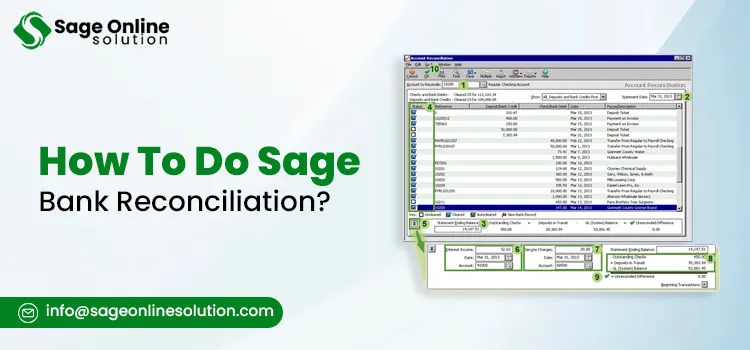
In Sage, go to your Bank module or Banking section. Select the account you want to reconcile, then choose the Reconcile or Bank Reconciliation option. Sage will display your unreconciled transactions alongside a field where you enter your statement's closing balance.
Step 3: Enter the Statement Date and Closing Balance
Input the end date of your bank statement and the closing balance exactly as shown on your statement. This is the target figure Sage will use to measure whether your records agree.
Step 4: Match Your Transactions
Go through each transaction on your bank statement and tick or mark the corresponding entry in Sage. Most versions of Sage allow you to sort by date or amount, which makes matching quicker. Payments, receipts, bank charges, and interest should all be accounted for.
Step 5: Investigate Any Differences
If the difference shown in Sage is not zero at the end of your matching, something doesn't line up. This could be a transaction you haven't recorded yet, a timing issue with a cheque that hasn't cleared, or a duplicate entry. This is where sage bank reconciliation problems most commonly appear — and where patience pays off.
Step 6: Post the Reconciliation
Once the difference is zero, you can save and post the reconciliation. Sage will mark those transactions as reconciled, and you'll have a clean audit trail for that period.
For hands-on help with any of these steps, call +1(844)341-4437 and a Sage specialist will guide you through the process in real time.
How to Do a Bank Reconciliation in Sage When Things Go Wrong
Even experienced users run into problems. Knowing how to do a bank reconciliation in Sage when something goes wrong is just as important as knowing the standard process. Here are the most common scenarios and how to handle them.
Transactions Appearing Twice
Duplicate transactions are a classic reconciliation headache. They usually happen when a bank feed imports a transaction that was also entered manually. To fix this, identify the duplicate, check which version is correct (the manually entered one or the imported one), and delete the incorrect entry before reattempting your reconciliation.
Bank Feed Not Updating
If your bank feed has stalled or isn't pulling in new transactions, check your connection settings in Sage. You may need to re-authenticate your banking credentials. If the feed has been disconnected for a while, you may need to manually import a statement file in CSV or OFX format.
Opening Balance Discrepancy
One of the trickier sage bank reconciliation problems to solve is an opening balance that doesn't match. This usually means a prior reconciliation was either incomplete or incorrectly posted. You'll need to go back to the previous period, identify what was missed or wrongly matched, and correct it before the current period will balance properly.
Uncleared Items from Previous Periods
Old uncleared items — cheques that were written months ago but never cashed, for example — can linger in your unreconciled list and cause confusion. Review these carefully. If a cheque is genuinely stale and will never clear, you may need to reverse or write it off.
Timing Differences
Sometimes a payment leaves your Sage records on the last day of the month but doesn't appear on your bank statement until the next day. These are normal timing differences and should be noted but not treated as errors. They'll typically clear in the following period's reconciliation.
Common Sage Bank Reconciliation Problems and How to Avoid Them
Understanding bank reconciliation Sage issues before they arise is the best strategy. Here are the most frequent problems and some practical prevention tips.
Irregular Reconciliation Schedule
The longer you wait between reconciliations, the harder they become. Monthly reconciliation is the minimum for most businesses; weekly is even better for high-volume accounts. Make it a non-negotiable routine.
Unposted Transactions
Transactions that have been entered but not fully posted in Sage won't appear in your reconciliation. Always make sure all transactions are properly saved and posted before starting the reconciliation process.
Incorrect Nominal Codes
Sometimes transactions are posted to the wrong nominal or account code. While this won't directly affect whether your bank reconciliation balances, it will cause problems in your financial reports. Get into the habit of reviewing nominal allocations as you reconcile.
Manual Entry Errors
Typos happen. A transposed digit — £1,540 entered as £1,450, for instance — can cause a reconciliation to fail and be surprisingly difficult to find. Using bank feeds wherever possible reduces this risk significantly.
Missing Bank Charges or Interest
Banks sometimes add charges or credit interest that aren't automatically recorded in Sage. Always scan your bank statement for these items and post them in Sage before reconciling.
If you're repeatedly running into bank reconciliation Sage issues that you can't resolve, don't waste hours guessing. Reach out to a qualified Sage advisor at +1(844)341-4437 for efficient, reliable support.
Tips for Faster, Cleaner Sage Bank Reconciliation
Once you've got the basics down, these tips will help you streamline the process and keep your books in excellent shape.
Use Bank Feeds Consistently
Sage's bank feed feature, where available, automatically imports transactions from your bank. This dramatically reduces manual data entry and the errors that come with it. Set it up once and keep it connected.
Reconcile One Account at a Time
If your business has multiple bank accounts, petty cash, or credit card accounts, tackle each one separately. Mixing them up is a recipe for confusion.
Keep Notes on Outstanding Items
For any item you can't immediately match, add a note explaining what it is and why it hasn't cleared. This saves you time when you revisit it next month.
Review Your Reconciliation Report
After posting, Sage generates a reconciliation report. Save or print this for your records. It's valuable documentation if questions arise later, and auditors will appreciate having it readily available.
Reconcile Before Running Financial Reports
Always complete your bank reconciliation before generating profit and loss reports, balance sheets, or tax summaries. Unreconciled transactions mean your reports may not reflect your true financial position.
When to Call for Help
Most sage bank reconciliation problems can be solved with patience and the right approach. But sometimes — especially when prior periods are involved, when the software is behaving unexpectedly, or when the discrepancy is significant — it's worth getting professional support.
Whether you're a sole trader doing your own books or a finance manager overseeing a team, there's no shame in picking up the phone. The team at +1(844)341-4437 specialises in Sage support and can help you diagnose and resolve even the most stubborn reconciliation issues quickly.
Final Thoughts
Sage bank reconciliation is a cornerstone of sound financial management. Done regularly and carefully, it keeps your accounts accurate, your reports trustworthy, and your business in good financial health. Understanding how to do bank reconciliation on Sage — and knowing how to handle the common problems that arise — puts you firmly in control of your numbers.
If you ever find yourself stuck, remember that expert help is just a call away. Reach the Sage support team at +1(844)341-4437 and get your reconciliation sorted without the stress.